
What do built-ins cost in Pattaya? How to plan the budget first
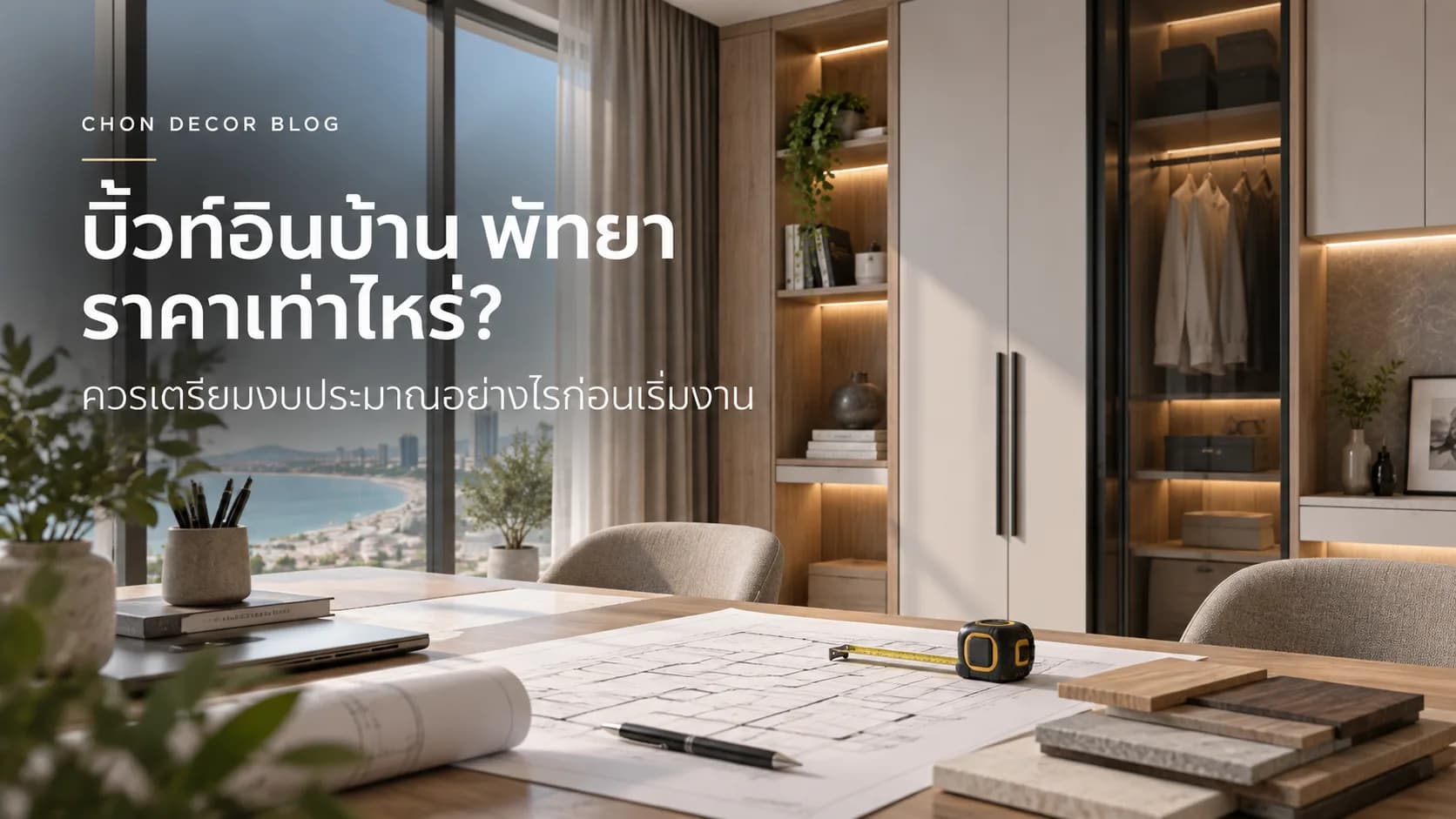
The question our team is asked most often is: how much should I budget to fit out the whole house?
Our answer: built-in pricing cannot be read off floor area alone. Two houses of similar size can differ enormously, because the detail differs — the materials, the door style, the hardware, glass, paintwork, down to LED lighting and the fittings inside each cabinet.
So rather than asking only for a price per square metre, it is more useful to understand what makes up that price. This article explains it from the point of view of the people who both design and manufacture the work.
Before asking the price, know what you are actually building
Many clients start with “I want built-ins throughout the house” — but that means something different to everyone. One house needs a TV unit, a wardrobe and a kitchen. Another includes:
- TV unit
- Feature panelling
- Shoe cabinet
- Storage
- Kitchen
- Wardrobe
- Walk-in closet
- Dressing table
- Desk
- Display shelving
- Under-stair storage
- Pantry
So before pricing, list every area you want done. It does not need to be detailed; a rough idea of each room already makes the estimate far closer.
Why identical sizes are not identically priced
Picture two wardrobes of the same size. The first has flat doors, a standard surface finish and standard hardware. The second has aluminium-framed glass doors, internal lighting, soft-close runners and extra internal fittings.
Same dimensions, different price. That is why we price on many factors together, not just width and height.
1. Carcass material
The carcass is one of the main cost drivers. Built-ins can use several materials, such as:
- Particle board
- MDF
- HMR
- Plywood
Each has its own properties, price and suitable application. Anywhere exposed to moisture needs the material chosen for that, not for price alone. The most expensive material is not automatically the best — using the right one in the right place is what matters.
2. Surface finish
After the carcass, the finish affects both price and appearance:
- Melamine
- PVC
- HPL
- Veneer
- Spray paint
Each finish feels different. Some suit homes that need easy maintenance; some give a more natural texture and grain; some are right where flatness and a premium feel are wanted. This is where a designer can adjust the specification to the budget most effectively.
3. Door style
Flat doors and heavily detailed doors do not cost the same:
- Flat
- Grooved
- Panelled
- Timber-framed glass
- Aluminium-framed glass
- Slatted
The more production steps involved, the higher the price. Not every house needs special doors throughout — use them at the focal points, such as a display cabinet or the walk-in closet, and keep flat doors elsewhere to hold the budget while the overall effect still reads well.
4. Hardware
Hardware is invisible in a 3D image but decisive in daily use:
- Hinges
- Drawer runners
- Soft close
- Handles
- Hanging rails
- Baskets
- Kitchen fittings
- Wardrobe fittings
It comes at many price levels, and some items we advise against downgrading too far, because they are opened and closed every day. A beautiful cabinet with a poor drawer, or a door that fails within a year, never feels like value.
5. Glass and aluminium work
Glass cabinets and aluminium frames are increasingly popular, especially in walk-in closets and display units. They make the work look lighter and more contemporary, but cost more than standard doors.
On a tight budget you do not need them everywhere — a few doors are enough to give the room a focal point.
6. Lighting
LED lighting inside built-ins is a small detail that changes the mood of a room considerably:
- Behind display shelving
- Under floating units
- Inside wardrobes
- At the headboard
- In feature recesses
But lighting is not just the LED strip. It also means aluminium channel, drivers, switches, cabling and the preparation of the supply points — which is why it belongs in the design stage rather than being added after the cabinets are installed.
7. Site condition
A new house and a lived-in house are different propositions. Renovation work often turns up:
- Out-of-square walls
- Uneven floors
- Lighting points in the wrong place
- Existing services to correct
- Old furniture to remove
- Access restrictions
All of it affects cost and duration. Seeing the site before finalising the price is what prevents added charges later.
So what should you budget?
We would rather clients did not fix on a per-square-metre figure, because the types of work differ so much. A TV unit, a wardrobe, a kitchen and a walk-in closet may occupy similar space but have quite different structures and internal fittings. We suggest splitting the budget into three levels:
- Must-have
- Would-like
- Can be added later
Must-have is what genuinely has to exist — wardrobe, kitchen, storage, basic function. Would-like adds beauty or convenience: glass display cabinets, feature lighting, upgraded hardware. The third level is what can wait; not everything has to happen on day one.
Split this way, going over budget does not mean cutting everything at random.
If the budget is tight, where do you cut first?
Do not cut everything at once — the whole job loses quality. Look instead at what affects long-term use versus what is decorative and adjustable.
For example: keep the hardware you touch daily at a good level, but reduce the number of glass doors; swap some spray paint for a finish that is easier to maintain; put feature lighting only where it is genuinely seen.
Good budget control is not removing everything expensive. It is spending where the difference is actually felt.
Why tell the designer your budget early
Some clients would rather not say, fearing the design will be drawn to consume exactly that amount. We understand the worry — but from the designer's side, knowing the range makes the direction far more accurate.
A client with 500,000 baht and a client with 1,500,000 baht should not receive the same material approach, even for the same space. Without a range, a designer may draw beyond reality, and the design has to be reworked repeatedly.
A range is enough: “we would like to keep it under about this much.” That alone lets the team set the approach.
Be careful with a price that looks far too low
When comparing quotes, do not read only the total. Look at what each one actually contains:
- Carcass material
- Surface finish
- Hardware brand
- Lighting included?
- Glass included?
- Delivery included?
- Installation included?
- Extra services work
Some quotes look cheaper at first but leave several items out, and the extra charges appear once work starts. Compare like specification with like specification, not final figure with final figure.
How does having our own workshop help?
Chon Decor runs its own built-in workshop. That does not mean we are always the cheapest — what it means is more control over:
- Production quality
- Drawing detail
- Production sequence
- Corrections
- Coordination
When the design team and the workshop speak directly, the problem it removes is work coming out differently from what the designer intended. If something needs changing, it is discussed directly rather than passed along a chain.
What Pattaya clients should think about as well
Pattaya projects vary widely:
- Family homes
- Pool villas
- Condos
- Holiday homes
- Properties owned but rarely occupied
For a property that is not occupied year-round we usually advise weighing ease of maintenance too. Some materials look superb but demand attention; if nobody is there regularly, an easier finish often serves better over time.
Condos bring building rules, permitted working hours, material access and space for on-site assembly. All of it is worth settling before work begins.
Five things to prepare before asking for an estimate
To let the team estimate faster, prepare these:
- 1. Photos of the space
- 2. Dimensions or a floor plan
- 3. List of rooms to be done
- 4. Reference images
- 5. A rough budget
This makes the conversation far more direct, and you do not need a full design before contacting us. Often photos plus “we want the living room, wardrobes and kitchen, roughly this budget” is enough for us to sketch an approach.
The more important question than price per square metre is what that price contains. If a higher price brings more suitable materials, better hardware, a design team that thinks the detail through and someone accountable to the end, slightly more can be the better value.
Looking for a built-in team in Pattaya, Chonburi or Rayong?
Chon Decor designs interiors and manufactures built-in work with our own design team and workshop. Our main service areas are:
- Pattaya
- Sattahip
- Sriracha
- Bo Win
- Chonburi
- Pluak Daeng
- Nikhom Phatthana
- Rayong
If you are planning a new home, a renovation, or want a built-in budget assessed, send us the details of the space.
For us a good estimate is not an attempt at the lowest number. It is making sure that, before work starts, you know what your money is going to — and whether your home genuinely needs it.
Let Chon Decor take care of your home
Initial consultation and estimate are free of charge.
Talk to us on LINE